
This one was an easy one. Tamar and I agreed she would send just three small paintings. No major logistics.
She shipped them from her hometown, Tbilisi, in what might be the most carefully made crate I have ever seen. Three small paintings, roughly 30 by 30 centimeters, placed inside an oversized box, almost disproportionate to their scale. Layers of bubble wrap, foam, carefully set nails, everything assembled by hand. The kind of attention that already says something about the work before you even see it. It felt like opening a pirate’s chest. Yet, she is not a pirate.
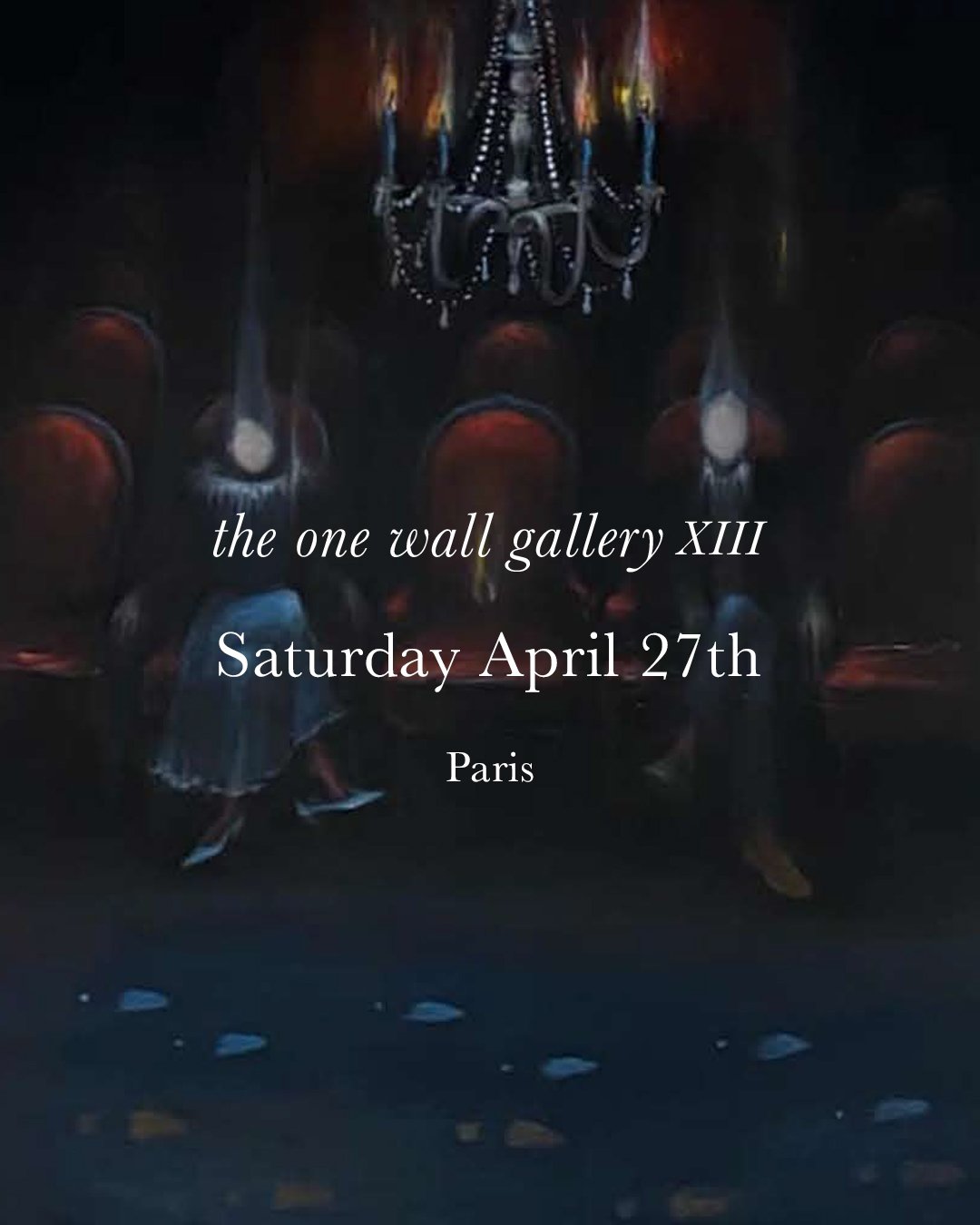
The three paintings all held variations of the same register: images of the dark night. Not dramatic, not illustrative, but quiet, dense. We placed them between the two windows, facing the back façade of a typical Parisian building, directly across from our apartment. A familiar view. At certain hours, the sun would enter the living room and shift the atmosphere slightly, something softer, more suspended. The paintings responded to that light. There is a photograph somewhere on my phone that still feels almost unreal. Alongside the three works, she included a larger painting as a gift, inspired by Hermann Hesse’s Steppenwolf, and the Magic Theater. We installed it on the second floor. At the end of the day, a very specific light would reach that corner indirectly. The painting would shift again, its chiaroscuro deepening, the image becoming more legible, but only briefly.
There are no clear faces in her work. Sometimes the figures feature a large pearl instead of a face, or a shell, or nothing at all. Tamar’s work operates in that space. Oil on canvas. She paints figures that are not entirely fixed: mostly women, presences, fragments of a symbolic world. The imagery draws from an interior register, closer to the subconscious than to observation. There is a quiet cosmology at play.
She paints angels.
Text by Patrick Steffen